
Networking
LACP
Also known as: Link Aggregation Control Protocol, LAG, Link Aggregation Group, Port Channel, NIC Teaming, Bonding
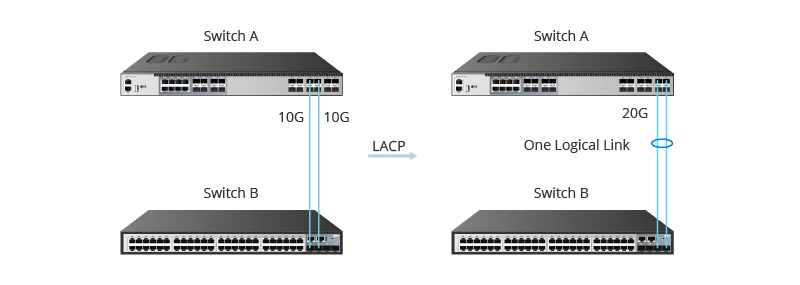
Combines multiple physical links into a single logical link — adding bandwidth and surviving a single cable failure. Two 10Gbps links become one 20Gbps.
LACP (Link Aggregation Control Protocol) combines multiple physical network links between two devices into a single logical link, adding bandwidth and providing redundancy. Two 10Gbps links become one 20Gbps logical connection that survives a single cable failure.
When one uplink between two switches isn't enough — either for bandwidth or redundancy — LACP lets you bond multiple physical ports into a single logical port channel. Both sides negotiate the aggregation automatically using the LACP protocol; the result is a link that appears as a single higher-bandwidth connection.
Common uses: uplinks between access and distribution switches, server connections to a switch (often called NIC teaming or bonding on the server side), and storage connections where both throughput and availability matter.

Traffic distribution across member links is handled by a hashing algorithm based on source/destination MAC addresses, IP addresses, or port numbers. This means a single flow (one TCP connection) still travels on one link — you won't see a single download speed double. The aggregate bandwidth benefits concurrent flows from multiple sources, not a single stream.
Key requirements: all member ports must be the same speed and duplex. A 1Gbps and a 10Gbps port cannot be in the same LAG. The same is true on both ends — both switches must have identical port speeds for the bundled interfaces.
LACP is defined in IEEE 802.3ad (now 802.1AX). Cisco's older proprietary equivalent is PAgP. Most modern equipment supports LACP natively; prefer it over vendor-specific protocols for interoperability.